Chain Reorgs and Checkout Confirmations: Bitcoin and Ethereum for Merchants
If you run a crypto checkout, a chain reorg is one of the reasons confirmation settings exist.
In plain English, a reorg means the network briefly had two possible recent versions of the chain, and then one of them won. A transaction on the losing branch can disappear from the main chain and then confirm again later.
For a merchant, that affects one practical checkout question:
when is a crypto payment stable enough to mark the order confirmed and fulfill it?
For most merchants, the answer is not "wait forever." It is "wait enough for the actual risk level of the order and the reversibility of the fulfillment."
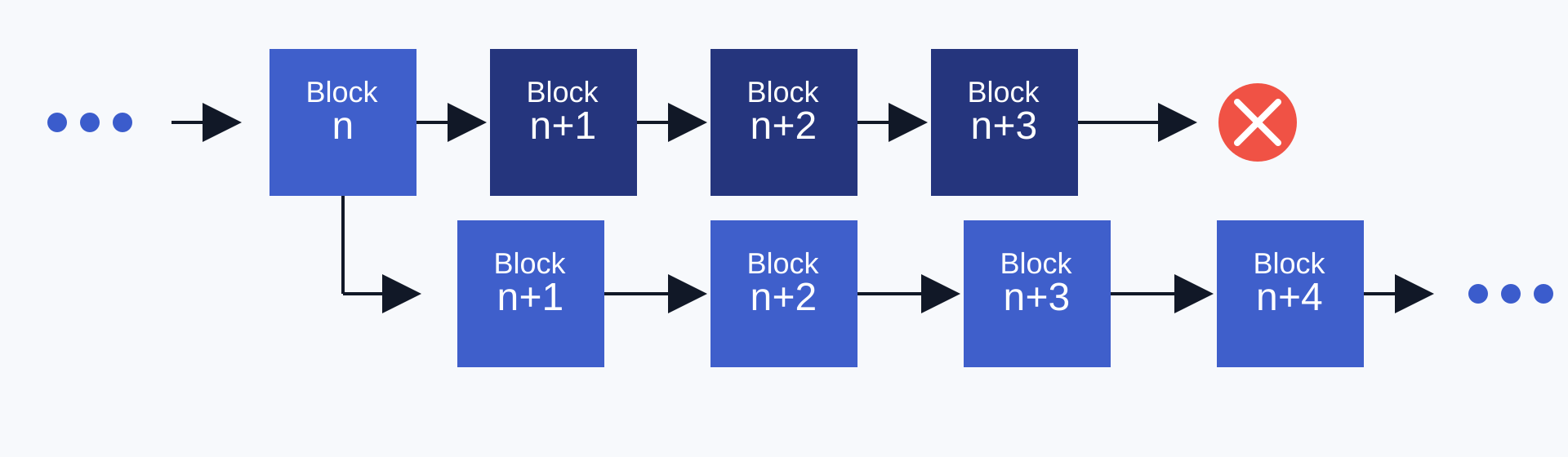
Why Reorgs Matter In Checkout
If you mark an order as final at 0 confirmations, you are trusting that the transaction will stay in the chain exactly as first seen. That can be acceptable for very low-risk flows, but it is not the same as confirmed settlement.
If you wait for a few confirmations, you reduce the chance that a short reorg changes the checkout payment status after you already fulfilled the order.
Checkout confirmations help you balance three things:
- buyer waiting time
- payment reversal and fraud risk
- the value and reversibility of the order or service
In other words, confirmations are not just blockchain trivia. They are part of order handling, payment status, and fulfillment timing.
Quick Bitcoin And Ethereum Context
Bitcoin
Bitcoin has always had probabilistic finality. Short forks are a normal part of proof-of-work when two miners find a block at nearly the same time.
The well-known exception was the March 11, 2013 chain split, when different Bitcoin versions temporarily disagreed on which chain to follow. It was unusual and is remembered because it was exceptional, not because it is a normal checkout outcome.
For merchant checkout, the more useful lesson is simpler:
0confirmations is meaningfully different from11confirmation already removes a lot of short reorg risk for normal orders- higher counts are mainly for higher-value or harder-to-reverse orders
Ethereum
Under proof-of-work, short reorgs were more familiar, so many apps learned to wait several confirmations before acting. After The Merge on September 15, 2022, Ethereum moved to proof-of-stake and gained stronger finality concepts such as "safe" and "finalized" blocks.
That improved the security model, but it did not make "instant" and "final" the same thing.
For checkout, the practical takeaway is:
- very recent Ethereum blocks can still be less stable than older ones
- a few confirmations are a reasonable default for normal checkout
- much deeper waiting is usually reserved for higher-value or more sensitive flows
Recommended Checkout Confirmation Settings
Users do not need to be limited to four fixed options.
The practical model for merchant checkout is:
| Network | Instant | Fast | Secure | Max custom |
|---|---|---|---|---|
| BTC | 0 | 1 | 3 | 6 |
| ETH | 0-1 | 3 | 6 | 12 |
That means a merchant can choose any value from 0 to 6 on Bitcoin, and any value from 0 to 12 on Ethereum. The named settings are useful defaults, not hard limits.
These checkout confirmation settings are not saying that every payment needs the maximum. They are saying:
Instantis convenience-firstFastis the normal defaultSecureis for higher-value ordersMaxis for unusually sensitive situations
How To Use The Presets
Think of Fast and Secure as recommended presets, not as the only valid settings.
Instant
Use this only for low-value, low-risk, or manually reviewed orders.
Fast
This is the right default for most merchants and most e-commerce orders.
It is a balanced checkout setting: short buyer wait, meaningful reduction in short reorg risk, and no unnecessary push toward the slowest option.
For Bitcoin, 1 confirmation is often enough for normal checkout. For Ethereum, 3 confirmations plays the same role.
Secure
Use this when the order value is higher or the product is harder to claw back after fulfillment.
Max
This is a special-case setting, not a recommendation for everyone.
If a merchant defaults everything to the highest possible confirmation count, the usual result is just slower checkout and more buyer friction.
That can be worth it for rare high-risk situations. It is usually not the right baseline.
The main mistake is acting as though 0 confirmations, 1 confirmation, and 6 confirmations all mean the same thing. They do not.
A small confirmation buffer helps stop a normal blockchain behavior from becoming a merchant-support problem:
- order marked confirmed too early
- fulfillment triggered too early
- buyer and merchant see conflicting payment states in checkout
Bottom Line
Chain reorgs are real, but they are not a reason to panic or max out every order.
They are one reason checkout systems should treat payment settlement as gradual instead of binary.
If you are unsure where to start, start with Fast:
BTC: 1ETH: 3
Then raise the requirement only when the order value, fraud profile, or fulfillment risk actually justifies it.